

FAQs
What are market share distributions?
When Congress passed the Music Modernization Act (MMA), it required The MLC to eventually distribute any remaining unclaimed accrued royalties, plus interest calculated at the statutory rate, to rightsholders based on their “relative market shares.” This congressionally mandated process is what The MLC refers to as “market share distributions.” The MLC will allocate the remaining royalties on a pro rata basis for each digital service provider (DSP) and offering and then distribute those royalties with interest calculated at the statutory rate.
What are unclaimed accrued royalties?
“Unclaimed accrued royalties” are royalties The MLC has received and has not been able to match or distribute (despite having attempted to do so) as of the expiration of the statutory minimum holding period prescribed in the MMA. Unclaimed accrued royalties include unmatched royalties and unclaimed royalties.
What are unmatched royalties?
Unmatched royalties are royalties related to sound recording resources reported by DSPs in the usage reports they provide to The MLC that have not yet been matched to a song in The MLC’s database.
What are unclaimed royalties?
Unclaimed royalties are royalties related to sound recording resources that have been matched to a song, but less than 100 percent of the shares of the work to which those uses have been matched have been claimed by a Member of The MLC. The royalties for shares that have not yet been claimed are called “unclaimed royalties.”
What is a sound recording resource?
A sound recording resource is a single instance of a sound recording that one DSP makes available for streaming or download. If multiple DSPs offer the same sound recording, each DSP’s version is treated as its own separate sound recording resource because each service reports its own specific data for that recording.
How long must The MLC hold royalties before distributing them via a market share distribution?
The MMA requires The MLC to hold (and continue efforts to match and distribute) royalties for a minimum of three years before distributing them via the congressionally mandated market share distribution process to rightsholders.
To date, The MLC has made no market share distributions. By the time The MLC makes the first market share distribution, The MLC will have held (and attempted to match and distribute) the unclaimed accrued royalties from 2021 usage for at least six years — twice as long as the three-year holding period set forth in the MMA.
When will The MLC begin market share distributions?
The MLC intends to begin market share distributions in early 2027, starting with remaining unclaimed accrued blanket royalties reported to The MLC for 2021 usage.
This timing is based on the data reflecting The MLC’s progress to date. That data shows that the current average match rate for all 2021 usage is now 94 percent, with several months of 2021 usage exceeding 94 percent. Moreover, only a small fraction of the sound recording resources reported in 2021 that remain unmatched — and a similarly small fraction of unclaimed shares of works — have accrued over $100 in cumulative royalties from 2021 usage. Although the match rates for 2021 usage continue to improve as The MLC continues to reprocess the remaining royalties, the rate of improvement has diminished over time.
How will The MLC allocate the remaining unclaimed accrued blanket royalties that are distributed via the market share distribution process?
How many months of remaining unclaimed accrued blanket royalties will be included in each distribution?
The MLC plans to distribute one month of remaining blanket royalties in each monthly royalty distribution, starting with the remaining royalties from January 2021 (the first month that DSPs reported royalties to The MLC according to the blanket license The MLC administers).
How much money does The MLC expect to be included in the first monthly market share distribution?
As of the completion of the January 2026 royalty distribution, The MLC was holding less than $7 million in remaining unmatched and unclaimed royalties from January 2021 usage. As of the completion of the September 2026 royalty distribution, the amount held had decreased to just over $6 million. This amount is expected to continue to decrease as The MLC continues its efforts to match and distribute royalties from this period in preparation for the first market share distribution in early 2027.
The MLC expects the remaining unclaimed accrued royalties from subsequent months of 2021 usage that are eligible to be distributed via the market share process will be comparable to the amount of those royalties from the January 2021 usage.
The MLC’s Unclaimed Accrued Royalties Dashboard offers monthly visibility into the remaining unclaimed accrued royalties associated with 2021 usage, including total royalty pools reported, amounts distributed or in dispute, and the remaining unclaimed accrued royalties that may be eligible for future market share distributions. Click here to view the dashboard.
Will the royalties distributed via the market share distributions appear on the regular monthly royalty statements The MLC provides to Members?
Yes. Once market share distributions begin in 2027, The MLC will include those additional royalties in the regular monthly royalty reporting. Members entitled to receive market share distributions will see these amounts clearly identified in their monthly royalty statements, broken down by DSP and offering, just as blanket royalties are currently reported each month. The MLC will also include metrics for these additional royalties in the aggregate distribution summaries provided in monthly Member newsletters, on The MLC’s website, and in The MLC’s Annual Reports.
Does the MMA require publishers and administrators who receive a distribution of unclaimed accrued royalties to pay a portion of those royalties to the songwriters they represent?
The MMA includes a specific provision concerning songwriter payments from market share distributions for songwriters with a publisher or administrator. That provision states:
Copyright owners that receive a distribution of unclaimed accrued royalties and accrued interest shall pay or credit a portion to songwriters (or the authorized agents of songwriters) on whose behalf the copyright owners license or administer musical works for covered activities, in accordance with applicable contractual terms, but notwithstanding any agreement to the contrary—
(I) such payments and credits to songwriters shall be allocated in proportion to reported usage of individual musical works by digital music providers during the reporting periods covered by the distribution from the mechanical licensing collective; and
(II) in no case shall the payment or credit to an individual songwriter be less than 50 percent of the payment received by the copyright owner attributable to usage of musical works (or shares of works) of that songwriter.
17 U.S.C. § 115(d)(3)(J)(iv)
When The MLC begins distributing the remaining unmatched and unclaimed royalties in 2027, we will include those additional royalties in our regular monthly royalty reporting. Members will see these amounts clearly identified in their monthly royalty statements, broken down by DSP and offering. This level of detail should enable those Members who administer works on behalf of songwriters to calculate and report payments or credits to those songwriters as the MMA requires.
What happens when a song has both claimed and unclaimed ownership shares?
Royalties for claimed shares of a song are paid to the owners of those claimed shares in our regular monthly distributions. If a song also has unclaimed shares, royalties for those shares are held separately. If those shares remain unclaimed, associated monthly royalties eventually become eligible for market share distribution. Royalties for the claimed shares are unaffected by any market share distributions.
Unclaimed shares of songs can always be claimed by the proper Member. When a song share is claimed by a Member, The MLC will distribute to the Member all related royalties held for past periods, together with statutory interest, excluding only royalties for periods that were already subject to a market share distribution.
What happens if a song is in dispute during a market share distribution period?
If a song or a portion of its ownership is in dispute, the royalties associated with that song are temporarily held until the dispute is resolved. These royalties are not distributed through market share distributions during this time.
For songs with ownership disputes or overclaimed shares, our dispute resolution process governs how those royalties are handled, and the MMA requires that disputed funds be held pending resolution. During this time, they are treated as neither unmatched nor unclaimed and therefore would not be distributed via a market share distribution.
When will The MLC start distributing the remaining unclaimed accrued historical royalties from 2007-2020?
Once the process for distributing the remaining unclaimed accrued blanket royalties has been successfully launched and is underway, The MLC will look to begin processing the remaining historical royalties. The MLC will share additional details about the anticipated timing for the start of distributions of the remaining historical royalties well ahead of their eventual start date. To see the progress The MLC has made so far distributing historical unmatched royalties, you can view The MLC’s Historical Royalties Dashboard here.
What is The MLC doing to prepare for the market share distribution process?
The MLC is continuing its efforts to match and distribute the remaining unclaimed accrued royalties while also developing the market share distribution process. The MLC is also conducting targeted outreach to try and find rightsholders who are not yet Members of The MLC and may be entitled to receive some of the remaining royalties from 2021 usage, along with targeted efforts to try and match and distribute the remaining royalties from 2021 usage.
What steps can rightsholders take today?
As always, The MLC encourages rightsholders to review and update their data regularly to ensure they receive all of the royalties to which they are entitled by:
- Making sure all of their songs are registered with The MLC and using The MLC’s Works Registration Tools to register any missing songs;
- Using The MLC’s Claiming Tool to make sure they have claimed their share of any song that was initially registered by another Member; and
- Using The MLC’s Matching Tool to review unmatched sound recordings and suggest matches to songs in their catalog.
Rightsholders can also review the Unclaimed Accrued Royalties Dashboard to better understand remaining accrued royalties from 2021 usage. Click here to view the dashboard.
What does “processing time” mean and how does The MLC measure it?
“Processing time” refers to the amount of time it takes to review and process submissions such as claims for shares of musical works, registrations of new musical works, and match suggestions between sound recordings and musical works. Processing time is generally measured from the time a submission is received until the submission has been reviewed, processed, and any approved changes have been applied to The MLC’s database.
How long does processing take and what factors can affect processing times?
Most submissions are processed within the following timeframes:
-
Work registrations and claims – typically processed within 21 days or less
-
Match suggestions – typically processed and reflected in The MLC Portal and database within approximately 30 days
These timeframes are based on The MLC’s current processing experience and are not guaranteed. Actual processing times may vary depending on submission volume, the type of submission, and whether additional information or review is needed. Submissions that are incomplete or require additional information may take longer to process.
What can be done to help facilitate timely processing?
Providing complete and accurate information can help facilitate timely processing. Before submitting a request, rightsholders should review the information carefully and, where applicable, check The MLC’s database to make sure the submission does not duplicate or conflict with existing information.
-
Claiming shares of existing works – Check the shares that have already been claimed and confirm the appropriate ownership percentage before submitting a claim.
-
Registering new works – Search The MLC’s database before registering a work to make sure it has not already been registered, and provide complete and accurate information.
-
Suggesting matches – Carefully review the available information to confirm that the sound recording corresponds to the musical work before submitting a match suggestion.
What is a database snapshot and why does The MLC use them?
As part of its royalty distribution process, The MLC takes a “snapshot” of the musical works data in its database each month. The snapshot provides a fixed set of data that The MLC uses when initially processing the usage data received from DSPs for a particular reporting period.
The MLC uses database snapshots to process usage data for a particular reporting period against a fixed set of musical works data rather than against a database that is continually changing. This helps ensure that matching and royalty calculations for a particular reporting period are performed against a consistent set of data.
What happens if a change or update is submitted after a database snapshot?
Changes or updates to your musical works data will not impact your royalties until they have been captured in the monthly database snapshot we use to process the usage reports we receive from DSPs. Once your change or update has been captured in a snapshot, any royalties generated will be distributed in a subsequent distribution.
When do database snapshots occur?
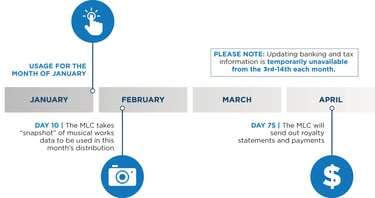
The MLC takes a database snapshot on or about the 10th day of each month. The MLC then processes the usage reported by DSPs using the applicable database snapshot as part of its royalty distribution process.
For example, The MLC would use the database snapshot taken on or about February 10 to process usage that took place in January. The first time The MLC would then distribute royalties to Members associated with those uses would be in the April distribution (approximately 75 days after the end of January). The following example shows key dates in The MLC's royalty distribution cycle that would cover the usage reported to by DSPs for the January reporting period.
How will The MLC use database snapshots for market share distributions?
Each market share distribution will use the same monthly database snapshot that The MLC uses for its regular monthly royalty distribution for that usage month.
Who can rightsholders contact with questions?
For questions about the market share distribution process or claiming royalties, contact The MLC’s Support Team via chat, phone, or email Monday – Friday, 8 a.m. – 6 p.m. CT.